 admin
admin 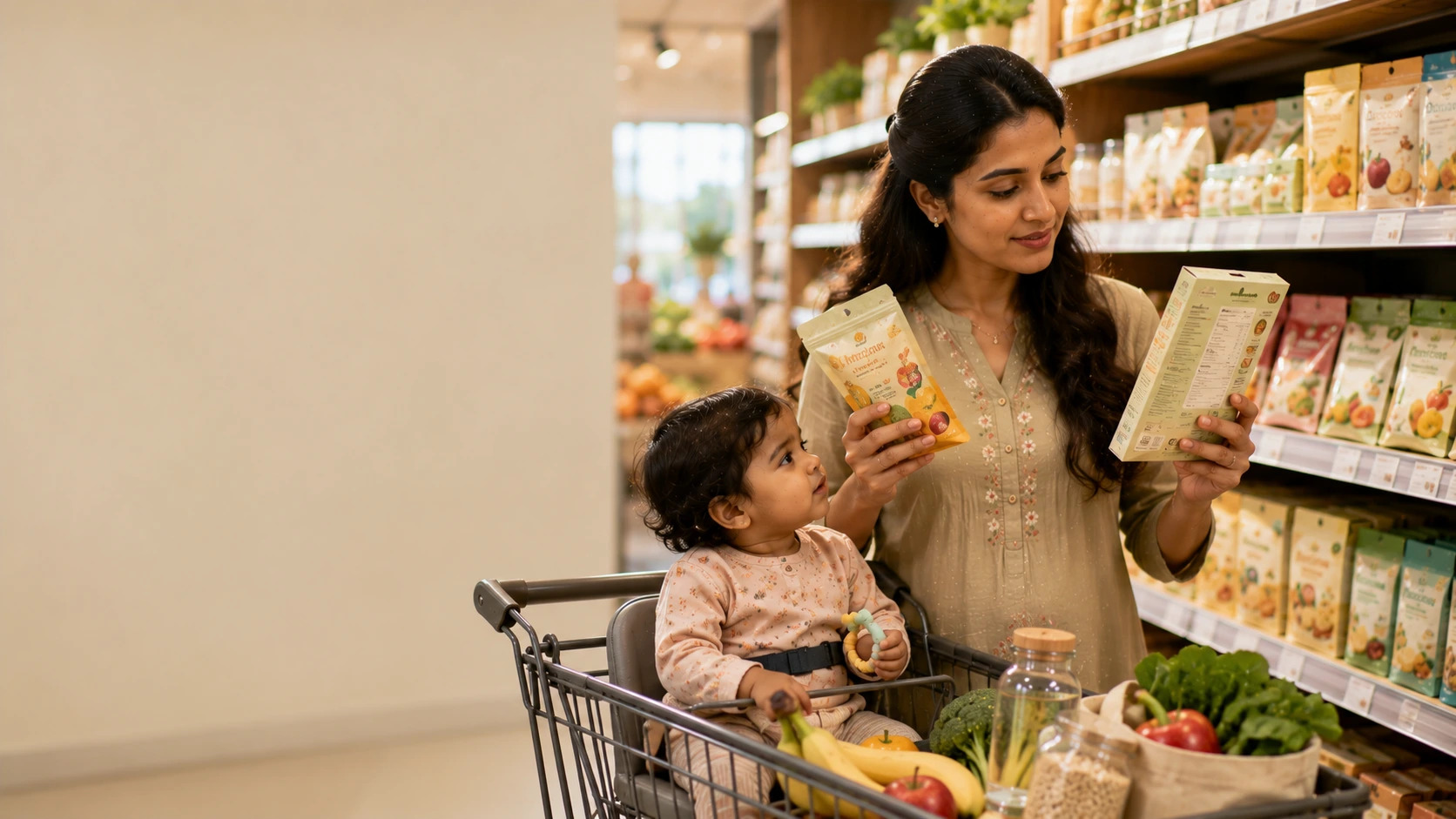
A parent standing in a supermarket aisle may compare three products that all appear suitable for young children. One package says “natural,” another highlights grains and fruit, and a third uses simple packaging that suggests clean label food.
But which product is the better choice?
For modern Indian parents, choosing clean ingredient baby food is not simply about finding the most attractive package or the product with the strongest health-focused message. It means understanding the ingredient list, checking nutritional information, considering the child’s age and feeding stage, and deciding how the product fits within the family’s overall eating routine.
This becomes especially important as parents balance homemade meals with the convenience of healthy packaged foods for babies during travel, daycare routines, busy workdays, or situations where preparing fresh food is difficult.
Food labels can help parents make more informed choices, but only when they know what information deserves attention.
Learning to read labels does not require becoming a nutrition expert.
Parents need a simple and repeatable process for moving from marketing claims on the front of the package to meaningful information on the back.
Why Food Labels Matter
Food labels help parents understand what they are actually buying.
This matters because baby and toddler products can differ significantly in their ingredients, nutritional composition, serving sizes, age recommendations, preparation instructions, storage requirements, and intended role in a child’s diet.
Two products may both appear to be healthy baby food, yet their ingredient lists and nutrition information may tell very different stories.
One may contain a short list of familiar ingredients.
Another may include added sweeteners, flavouring substances, several processed ingredients, or ingredients parents do not immediately recognize.
The purpose of reading labels is not to classify every packaged product as “good” or “bad.”
The purpose is to make informed comparisons.
Front-of-Pack Claims Are Only the Starting Point
Parents commonly encounter phrases such as:
- Natural
- Made with real fruit
- Multigrain
- No added preservatives
- High in nutrients
- Organic
- Wholesome
- Healthy
- Suitable for children
These claims may provide useful information, but they should not replace reading the complete label.
A product marketed as natural baby food may still contain multiple ingredients that deserve closer attention.
A product positioned as organic snacks may still need to be evaluated for added sugars, sodium, serving size, age appropriateness, and overall ingredient composition.
Similarly, preservative free baby food should be assessed by looking at the complete ingredient list and understanding how the product is processed, packaged, stored, and intended to be consumed.
The front of the package attracts attention.
The ingredient list and nutrition information help parents evaluate the product.
Why Label Reading Matters More for Babies and Toddlers
Babies and toddlers are developing eating habits and becoming familiar with flavours, textures, and family food routines.
Parents therefore often think carefully about the products they introduce.
A practical label-reading process can help parents evaluate:
| Parent Concern | Label Information to Review |
| What ingredients are used? | Ingredient list |
| Is the product appropriate for my child’s age? | Age guidance and feeding instructions |
| Does the product contain added sweeteners? | Ingredient list and nutrition information |
| How much sodium does it contain? | Nutrition information panel |
| Are allergens clearly declared? | Allergen statement and ingredient list |
| How should the product be prepared? | Preparation instructions |
| How should it be stored? | Storage instructions |
| How long can it be used after opening? | Usage and storage guidance |
| Who manufactures the product? | Manufacturer and regulatory information |
| How does it compare with another product? | Ingredients, nutrition values, serving sizes, and intended use |
Parents searching for the safest packaged food for toddlers often want one simple label or claim that provides complete reassurance.
In practice, informed shopping requires evaluating several pieces of information together.
Food Labels Support Ingredient Transparency
Ingredient transparency is an important trust signal for parents.
A clear label allows families to understand what the product contains and decide whether it aligns with their preferences, child’s feeding stage, and overall nutrition routine.
This is particularly relevant for parents looking for healthy packaged food or healthy packaged foods for babies.
Transparency can include:
- A complete ingredient list
- Clearly identified allergens
- Understandable nutrition information
- Appropriate preparation guidance
- Storage instructions
- Age-related information where relevant
- Clear manufacturer details
- Claims that can be evaluated against the rest of the label
Many parents today prefer products with simple, transparent ingredient information because clarity can reduce uncertainty during purchase decisions.
Brands such as Tiny Tums reflect this trust-first approach by focusing on preservative-free nutrition, ingredient transparency, and parent-friendly choices for modern families.
Parent Scenario: Three Products, Similar Claims
Neha is shopping for a convenient snack for her two-and-a-half-year-old daughter before an upcoming train journey from Mumbai to Pune.
She finds three products.
Product A says “Made With Real Fruit.”
Product B says “Multigrain Nutrition for Growing Children.”
Product C says “No Added Preservatives.”
All three products sound appealing.
Previously, Neha might have chosen the product with the most reassuring front-of-pack claim.
Instead, she turns the packages around.
She checks:
- The ingredient list.
- The order of ingredients.
- Whether added sweeteners appear.
- The sodium information.
- The serving size.
- The allergen declaration.
- The recommended age.
- The preparation and storage instructions.
After comparing the products, she chooses the one that best fits her daughter’s age, usual eating routine, and the purpose of the snack.
The label did not make the decision for her.
It gave her information to make a more confident decision.
Myth vs Fact: Reading Children’s Food Labels
| Myth | Fact |
| “If the package says natural, I do not need to read the ingredients.” | Front-of-pack claims should be considered alongside the complete ingredient list and nutrition information |
| “The product with the shortest ingredient list is always the healthiest.” | Ingredient quality, product purpose, processing, nutrition information, and age appropriateness also matter |
| “All packaged foods are nutritionally the same.” | Products can differ significantly in ingredients, added sugars, sodium, serving sizes, and intended use |
| “If I cannot pronounce an ingredient, it must be harmful.” | Ingredient names can sound unfamiliar without automatically indicating that they are unsafe |
| “The front of the package contains the most important information.” | The complete label provides more useful information for comparison |
| “One healthy claim tells me everything I need to know.” | Parents should evaluate the full product rather than relying on a single claim |
Quick Takeaway for Parents
When evaluating healthy food for kids, remember:
Do not stop at the front of the package.
Turn the product around.
Read the ingredients.
Review the nutrition information.
Check the serving size.
Confirm age appropriateness.
Review allergens, preparation, and storage guidance.
Then compare the product with realistic alternatives.
This simple habit can make shopping decisions more informed and less overwhelming.
Understanding Ingredient Lists
The ingredient list is one of the most useful parts of a food label.
It tells parents what ingredients are used to make the product.
However, reading an ingredient list effectively requires more than counting the number of ingredients.
Parents need to understand ingredient order, recognize different names for similar ingredients, consider the purpose of ingredients, and evaluate the complete product.
Ingredients Are Listed in Order
Ingredients on packaged foods are generally listed in descending order by weight at the time the product is manufactured.
This means the ingredients appearing near the beginning of the list usually make up a larger proportion of the product than ingredients appearing near the end.
For parents choosing clean ingredient baby food, the first few ingredients deserve particular attention.
Consider these simplified hypothetical examples.
Product A Ingredients:
Whole grain oats, banana powder, milk powder, cinnamon.
Product B Ingredients:
Refined flour, sugar, vegetable oil, fruit concentrate, flavouring substance.
Both products may use child-friendly packaging.
However, the ingredient lists show different product compositions.
The purpose of comparison is not to judge products only by ingredient count.
It is to understand what the product is primarily made from.
Start With the First Three to Five Ingredients
When parents feel overwhelmed by a long label, a practical starting point is to examine the first three to five ingredients.
Ask:
□ What is the main ingredient?
□ Is it a food I expected to find in this product?
□ Are grains whole or refined where that distinction is relevant?
□ Does a sweetening ingredient appear near the beginning?
□ Are oils or fats major ingredients?
□ Does the product contain ingredients that fit its stated purpose?
□ Does the overall composition make sense for my child’s age and eating routine?
This quick scan can make comparing products easier.
Sample Ingredient List Breakdown
Consider a hypothetical toddler snack with the following ingredient list:
Whole grain ragi flour, oats, banana powder, ground sesame, vegetable oil, cinnamon.
| Ingredient | What Parents Can Consider |
| Whole grain ragi flour | Main grain ingredient and first item listed |
| Oats | Additional grain ingredient |
| Banana powder | Contributes fruit-based flavour and composition |
| Ground sesame | Ingredient that requires attention to allergen considerations |
| Vegetable oil | Fat used within the product formulation |
| Cinnamon | Flavouring spice |
The goal of this exercise is not to declare the product suitable for every child.
Parents still need to consider age appropriateness, allergies, texture, nutritional information, serving size, preparation instructions, and the child’s overall diet.
Familiar Ingredients Can Improve Clarity, but Context Still Matters
Many parents prefer clean label food with ingredients they recognize.
This preference is understandable.
Simple ingredient communication can make shopping less confusing.
However, “recognizable” does not automatically mean nutritionally appropriate in unlimited amounts.
Sugar, salt, butter, fruit concentrate, and refined flour are all familiar ingredients.
Parents should therefore avoid using ingredient familiarity as the only measure of product quality.
A stronger question is:
“What role does each ingredient play, how much of the product does it represent, and how does the complete product fit into my child’s diet?”
Watch for Different Names for Sweetening Ingredients
Sweetening ingredients can appear under different names.
Depending on the product, parents may encounter terms such as:
- Sugar
- Sucrose
- Glucose syrup
- Dextrose
- Maltose
- Fructose
- Invert sugar syrup
- Jaggery
- Honey
- Fruit juice concentrate
The presence of one of these ingredients does not tell parents everything about the complete product.
However, identifying sweetening ingredients helps parents understand the formulation and compare alternatives.
This becomes especially relevant when evaluating healthy snacks for children and products consumed frequently.
Ingredient Length Alone Does Not Determine Product Quality
A common label-reading shortcut is:
“Short ingredient list equals healthy product.”
This can be useful as an initial observation, but it is incomplete.
Consider two hypothetical products.
| Product A | Product B |
| Refined flour | Whole grain oats |
| Sugar | Ragi |
| Vegetable oil | Banana powder |
| Salt | Milk powder |
| 4 ingredients | Ground seeds |
| Cinnamon | |
| 6 ingredients |
Product A has fewer ingredients.
That does not automatically make it the more suitable choice.
Parents should evaluate:
- The primary ingredients
- Added sugars or sweeteners
- Sodium
- Ingredient purpose
- Nutritional composition
- Age appropriateness
- Serving size
- Frequency of consumption
- The child’s overall eating pattern
Parent Scenario: “I Don’t Understand Half the Ingredients”
A first-time mother in Hyderabad is comparing two healthy packaged foods for babies.
One product has six familiar ingredients.
Another has twelve ingredients, including several names she does not recognize.
She immediately assumes the longer list means the second product is unsafe.
Instead of making a decision based only on unfamiliarity, she can ask:
- What are the first few ingredients?
- Why might the unfamiliar ingredients be present?
- Are allergens clearly declared?
- What does the nutrition information show?
- Is the product appropriate for her baby’s feeding stage?
- Are preparation and storage instructions clear?
- Can she verify unfamiliar ingredients using reliable sources?
This approach replaces ingredient anxiety with informed evaluation.
Ingredient Checklist for Parents
When choosing clean ingredient baby food, check:
□ Are ingredients listed clearly?
□ What are the first three to five ingredients?
□ Does the primary ingredient match what the product claims to be?
□ Are added sweetening ingredients present?
□ Are several sweetening ingredients used under different names?
□ Are allergens clearly identified?
□ Do I understand the role of the main ingredients?
□ Is the product appropriate for my child’s age?
□ Have I checked the nutrition information instead of relying only on ingredients?
□ Does the product fit into my child’s overall dietary variety?
Practical Takeaway
An ingredient list should help parents answer three questions:
What is this product mainly made from?
Are there ingredients I need to pay closer attention to?
How does this product compare with realistic alternatives?
Parents looking for clean ingredient baby food, preservative free baby food, or healthy packaged foods for babies do not need to search for a perfect product.
They need a reliable process for evaluating ingredient transparency, nutrition information, age appropriateness, and the role the product will play within the child’s overall eating routine.
What Parents Should Check First
When parents pick up a baby or toddler food product, the amount of information on the package can feel overwhelming.
Ingredient lists, nutrition values, serving sizes, age recommendations, allergen statements, health-focused claims, preparation directions, storage instructions, and manufacturer information may all compete for attention.
A simple checking order can make the process easier.
Parents evaluating clean ingredient baby food, healthy packaged foods for babies, or healthy food for kids do not need to analyze every detail at once.
They can follow a repeatable decision framework.
The 7-Step Parent Label Check
| Step | What to Check | Why It Matters |
| 1 | Age appropriateness | Helps determine whether the product is intended for the child’s feeding stage |
| 2 | First three to five ingredients | Shows what the product is primarily made from |
| 3 | Added sweetening ingredients | Helps parents understand the role of added sweetness in the product |
| 4 | Sodium information | Supports comparison between similar products |
| 5 | Allergen declaration | Helps families identify ingredients that require attention |
| 6 | Serving size | Provides context for interpreting nutrition information |
| 7 | Preparation, storage, and manufacturer information | Helps parents use the product as intended and evaluate transparency |
This framework can be especially useful for working parents shopping quickly in supermarkets, ordering groceries online, or comparing products before travelling with young children.
1. Check Whether the Product Is Appropriate for Your Child’s Age
Age appropriateness should come before marketing claims.
A product may appear nutritious, convenient, and child-friendly, but parents should still check whether it is suitable for their child’s age and feeding abilities.
Babies and toddlers develop chewing, swallowing, and self-feeding skills gradually.
A product appropriate for a three-year-old may not be suitable for a baby beginning complementary feeding.
Parents should review:
□ Recommended age
□ Texture and consistency
□ Preparation instructions
□ Serving guidance
□ Allergen information
□ Whether adult supervision is recommended
□ Whether the child can safely manage the food’s shape and texture
Parents choosing baby food or healthy snacks for babies should consider the child’s developmental readiness alongside the product’s nutritional composition.
2. Read the First Three to Five Ingredients
The first few ingredients provide a quick picture of the product’s basic composition.
Ask:
What is this product mainly made from?
For example, imagine two hypothetical toddler cereals.
Product A:
Whole grain oats, ragi flour, banana powder, milk powder, cinnamon.
Product B:
Refined flour, sugar, vegetable oil, maltodextrin, flavouring substance.
The comparison does not automatically tell parents which product is appropriate for their child.
However, it provides useful information about what each product primarily contains.
Parents seeking clean label food can use the first few ingredients as a practical starting point before examining the rest of the label.
3. Look for Added Sweetening Ingredients
Young children can become familiar with different levels of sweetness through repeated food exposure.
Parents therefore often want to understand whether sweetening ingredients have been added to packaged foods.
Check the ingredient list for terms such as:
- Sugar
- Sucrose
- Glucose syrup
- Dextrose
- Maltose
- Fructose
- Invert sugar syrup
- Jaggery
- Honey
- Fruit juice concentrate
The objective is not to panic when a sweetening ingredient appears.
The objective is to understand the formulation.
Ask:
How frequently will my child eat this product?
Where does the sweetening ingredient appear in the ingredient list?
Are multiple sweetening ingredients used?
Is there another comparable product with a composition that better fits our family’s preferences?
This approach is more practical than choosing products solely because the front of the package uses words such as “natural” or “wholesome.”
4. Review Sodium Information
Sodium can come from naturally occurring sources and ingredients added during food preparation or manufacturing.
Parents should check the nutrition information and compare similar products using equivalent serving sizes or quantities.
For example:
| Product | Sodium per 100 g | Practical Comparison |
| Product A | 120 mg | Lower among the three hypothetical options |
| Product B | 280 mg | Moderate relative to the comparison |
| Product C | 460 mg | Higher among the three hypothetical options |
These numbers are illustrative only.
The important habit is comparison.
A single number without context can be difficult to interpret.
When parents compare similar products, nutrition labels become more useful.
5. Check the Allergen Declaration
Foods such as milk, wheat, soy, peanuts, tree nuts, sesame, and other ingredients may require attention depending on the child’s individual circumstances.
Parents should review both:
- The complete ingredient list
- The allergen declaration
Do not rely only on the product name or front-of-pack imagery.
For babies who are beginning new foods, parents should follow age-appropriate feeding guidance and seek professional advice when they have concerns about allergies or previous reactions.
6. Understand the Serving Size
Serving size is one of the most commonly overlooked parts of food labels.
A parent may see a relatively small amount of sugar, sodium, or another nutrient listed on the nutrition panel without noticing that the stated serving size is much smaller than the amount the child actually eats.
For example:
Nutrition label serving size: 15 g
Amount the child usually eats: 30 g
The actual intake would be based on two stated servings.
Parents comparing healthy packaged food should therefore check whether they are comparing:
- Per serving values
- Per 100 g values
- Different serving sizes
- Different product categories
Comparing products using the same measurement basis provides a clearer picture.
7. Review Preparation, Storage, and Manufacturer Information
The complete label should provide practical information about using the product appropriately.
Check:
□ Preparation instructions
□ Storage requirements
□ Guidance after opening
□ Best-before or use-by information
□ Manufacturer details
□ Customer care information
□ Required regulatory information
□ Batch or lot identification
These details can contribute to parent confidence and product transparency.
For families looking for trusted baby food brands India, trust is often built through clear communication rather than a single health-focused claim.
Quick Decision Framework: The Parent Label Test
Before buying a packaged product for a baby or toddler, ask:
AGE: Is this suitable for my child’s age and feeding skills?
INGREDIENTS: What are the first few ingredients?
SWEETNESS: Are sweetening ingredients added, and where do they appear?
SODIUM: How does the sodium content compare with similar products?
ALLERGENS: Are allergens clearly identified?
SERVING: What amount does the nutrition information represent?
TRANSPARENCY: Are preparation, storage, and manufacturer details clearly communicated?
If parents can answer these questions, they are already making a more informed purchase decision.
Common Ingredients That Cause Confusion
One of the biggest challenges parents face while reading labels is encountering ingredients they do not recognize.
An unfamiliar ingredient can create immediate concern.
However, unfamiliarity alone does not determine whether an ingredient is appropriate or inappropriate.
Food ingredients may have technical names because they perform specific functions related to texture, stability, flavour, acidity, nutrition, processing, or shelf life.
The more useful question is:
What is the ingredient, why is it present, and how does it fit into the complete product?
Why Ingredient Names Can Sound Complicated
Packaged food labels may contain:
- Scientific names
- Regulatory names
- Names of vitamins and minerals
- Acidity regulators
- Thickening agents
- Emulsifiers
- Antioxidants
- Flavouring substances
- Sweetening ingredients
- Ingredients used for texture or stability
Parents searching for clean ingredient baby food may naturally prefer products with straightforward ingredient lists.
However, making informed decisions requires understanding context rather than automatically rejecting every unfamiliar term.
Common Ingredient Categories Parents May Encounter
| Ingredient Category | Why It May Be Used | What Parents Can Check |
| Sweetening ingredients | Sweetness, flavour, product formulation | Ingredient position, frequency of consumption, alternative products |
| Oils and fats | Texture, energy, cooking, product structure | Type of fat, position in ingredient list, overall product composition |
| Starches | Thickening, texture, product stability | Source of starch and role in the product |
| Milk powders | Nutrition, flavour, texture | Allergen information and overall formulation |
| Fruit powders | Flavour, colour, ingredient composition | Amount where declared and presence of added sweeteners |
| Acidity regulators | Control acidity and product stability | Ingredient identity and product context |
| Emulsifiers | Help ingredients remain mixed | Purpose and complete ingredient formulation |
| Antioxidants | Help reduce oxidation | Type of antioxidant and product context |
| Flavouring substances | Provide or maintain flavour | Whether flavouring is used and how the product fits into the child’s overall diet |
| Fortified nutrients | Add specific vitamins or minerals | Amounts provided and whether the product is intended to supplement a particular dietary need |
This framework helps parents move from:
“I do not recognize this ingredient, so the product must be bad.”
to:
“I want to understand why this ingredient is present before making my decision.”
“Natural” Does Not Automatically Mean Nutritionally Superior
The word “natural” can strongly influence purchase decisions.
Parents may associate it with simplicity, safety, or better nutrition.
However, products marketed as natural baby food should still be evaluated using the complete label.
Parents should check:
- Primary ingredients
- Added sweetening ingredients
- Sodium
- Serving size
- Allergens
- Nutrition information
- Age appropriateness
- Preparation requirements
- Storage instructions
A health-focused word on the package should not replace product evaluation.
“Organic” and “Healthy” Are Not the Same Question
Parents may choose organic snacks because organic sourcing aligns with their family preferences.
However, organic certification and overall nutritional composition answer different questions.
A product can use organically produced ingredients and still contain:
- Added sweetening ingredients
- Significant sodium
- Refined ingredients
- A formulation that should be consumed occasionally rather than frequently
Similarly, a product that does not carry an organic claim may still contain ingredients that fit well within a family’s overall dietary pattern.
Parents should evaluate organic claims alongside the complete nutritional profile.
Fruit-Based Ingredients Can Require Closer Attention
Products containing fruit may appear naturally sweet and child-friendly.
However, fruit can appear in several forms:
- Whole fruit
- Fruit puree
- Dried fruit
- Fruit powder
- Fruit juice
- Fruit juice concentrate
- Fruit flavouring
These ingredients are not nutritionally identical.
Parents should look at the complete ingredient list and nutrition information rather than relying only on fruit imagery on the package.
Refined Grains vs Whole Grains
Grain-based products are common among healthy snacks for children, cereals, biscuits, puffs, and toddler foods.
Parents may encounter:
- Whole wheat
- Whole grain oats
- Ragi
- Jowar
- Bajra
- Refined wheat flour
- Rice flour
- Corn flour
- Multigrain blends
The word “multigrain” simply indicates that multiple grains are present.
It does not automatically mean that all grains are whole grains.
Parents can check the ingredient list to understand which grains are used and where they appear.
Maltodextrin
Maltodextrin is an ingredient parents may notice in some packaged foods.
Its unfamiliar name can create concern.
Rather than evaluating the product based only on the presence of one ingredient, parents can consider:
- Why the ingredient is included
- Where it appears in the ingredient list
- The overall nutritional composition
- The product’s intended use
- How frequently the child consumes the product
- Comparable alternatives
This complete-product approach can be applied to many unfamiliar ingredients.
Flavouring Substances
Flavouring substances may be used to create, enhance, or maintain flavour.
Parents should check whether flavouring substances are listed and consider the overall role of the product in the child’s diet.
A child who frequently eats strongly flavoured packaged products may have a different food exposure pattern from a child whose regular diet includes a wide variety of home-cooked foods and naturally varied flavours.
The goal is not perfection.
The goal is dietary balance and informed product selection.
Parent Scenario: The Ingredient Google Search Spiral
A parent in Bengaluru is shopping online for healthy packaged foods for babies.
She finds a product with nine ingredients.
She recognizes seven of them but not two.
She searches the unfamiliar ingredients online.
Within minutes, she encounters social media videos, blogs, discussion forums, influencer posts, and conflicting opinions.
Her anxiety increases.
A more reliable approach would be:
- Identify the unfamiliar ingredient accurately.
- Check why it is used in food products.
- Consult reliable regulatory or health information.
- Consider its position in the ingredient list.
- Evaluate the complete nutritional profile.
- Compare the product with realistic alternatives.
- Seek professional guidance when individual health concerns are involved.
Ingredient research should create clarity, not more confusion.
Myth vs Fact: Confusing Ingredients
| Myth | Fact |
| “Every unfamiliar ingredient is harmful.” | Ingredient names may be unfamiliar because they use technical or regulatory terminology |
| “Natural ingredients are always better.” | The complete product composition and dietary context still matter |
| “Organic products are automatically nutritionally superior.” | Organic sourcing and nutritional composition should be evaluated separately |
| “Fruit on the package means the product is mostly fruit.” | Parents should check the ingredient list to understand the actual product composition |
| “Multigrain always means whole grain.” | Products can contain multiple refined or whole grains, so the ingredient list matters |
| “One ingredient determines whether a product is healthy.” | Parents should evaluate the complete formulation, serving size, frequency, and role in the child’s diet |
Practical Takeaway
When an ingredient causes confusion:
Identify it. Understand its purpose. Check reliable information. Review its position in the ingredient list. Evaluate the complete product. Compare alternatives.
This process supports informed decision-making without turning everyday shopping into an exhausting search for perfection.
Understanding Added Sugar and Sodium
Added sugar and sodium are two areas that frequently influence how parents compare children’s food products.
They are also areas where front-of-pack messaging can create confusion.
A product may highlight fruit, grains, vitamins, or other ingredients while still requiring parents to examine the nutrition information and ingredient list carefully.
Understanding added sugar and sodium helps families evaluate healthy packaged food, clean label food, and healthy snacks for children more confidently.
Understanding Added Sugar
Added sugars are sweetening ingredients introduced during food preparation or manufacturing.
Depending on the product, parents may encounter:
- Sugar
- Sucrose
- Glucose syrup
- Dextrose
- Fructose
- Maltose
- Invert sugar syrup
- Jaggery
- Honey
- Syrups
- Fruit juice concentrates used for sweetening
Parents should read both the ingredient list and nutrition information.
The ingredient list shows what ingredients are used.
The nutrition panel provides quantitative information according to the label format.
“No Refined Sugar” Does Not Necessarily Mean “No Added Sweeteners”
A product may avoid refined white sugar while using:
- Jaggery
- Honey
- Date syrup
- Coconut sugar
- Fruit concentrate
- Other sweetening ingredients
Parents should evaluate the complete formulation rather than focusing only on whether refined sugar appears.
This is especially useful when comparing healthy packaged foods for babies or products marketed toward young children.
Naturally Occurring Sugars and Added Sweeteners Are Different Considerations
Foods such as milk and fruit naturally contain sugars.
A product may therefore contain total sugars even when no sweetening ingredient has been added.
Parents should use the ingredient list alongside the nutrition panel to understand the source of sweetness.
Ask:
- Does the product naturally contain ingredients that contribute sugars?
- Are additional sweetening ingredients listed?
- How frequently will my child eat this product?
- How does it compare with similar alternatives?
Added Sugar Comparison Example
Consider three hypothetical products.
| Product | Sweetening Ingredients | Total Sugars per 100 g | Parent Consideration |
| Product A | No added sweetening ingredient listed | 8 g | Review whether sugars come from ingredients naturally present in the product |
| Product B | Jaggery | 18 g | Consider quantity, ingredient position, serving size, and consumption frequency |
| Product C | Sugar, glucose syrup | 27 g | Multiple added sweetening ingredients may deserve closer comparison with alternatives |
These figures are illustrative.
The key lesson is that parents should combine ingredient-list reading with nutrition information.
Understanding Sodium
Sodium is a mineral naturally present in some foods and can also come from ingredients added during food manufacturing.
Parents often associate sodium only with table salt.
However, packaged products can contain sodium from multiple ingredients.
Parents should review the nutrition information panel and compare similar products.
Compare Similar Products on the Same Basis
Imagine a parent comparing three toddler snacks.
Product A: 45 mg sodium per 20 g serving.
Product B: 70 mg sodium per 30 g serving.
Product C: 180 mg sodium per 100 g.
These numbers cannot be compared directly without converting them to the same measurement basis.
A clearer comparison would use values per 100 g.
| Product | Sodium per 100 g |
| Product A | 225 mg |
| Product B | Approximately 233 mg |
| Product C | 180 mg |
Now the products can be compared more meaningfully.
Frequency Matters
The nutritional role of a product depends partly on how often it is consumed.
A packaged snack eaten occasionally during travel has a different role from a product consumed twice every day.
Parents should consider:
- Frequency
- Portion size
- Overall dietary pattern
- Other sources of added sugars and sodium
- Availability of minimally processed foods
- The child’s age and individual needs
Parents looking for snacks without preservatives for kids or healthy snacks without preservatives India should still evaluate added sweeteners, sodium, ingredient quality, and serving sizes.
One desirable product attribute does not replace complete label reading.
Healthy Swap Framework for Parents
| Instead of Choosing Based Only On | Also Check |
| “No refined sugar” | Whether other sweetening ingredients are added |
| “Made with fruit” | The form and position of fruit ingredients |
| “Low sodium” | Serving size and comparison with similar products |
| “Natural” | Complete ingredient list and nutrition information |
| “Organic” | Added sweeteners, sodium, and overall formulation |
| “No added preservatives” | Ingredients, nutrition values, storage requirements, and intended frequency of consumption |
| “For growing children” | Age appropriateness and complete product composition |
Do vs Don’t: Evaluating Sugar and Sodium
| Do | Don’t |
| Read both ingredients and nutrition information | Judge the product only by front-of-pack claims |
| Compare similar products using the same measurement basis | Compare different serving sizes without adjustment |
| Identify different names for sweetening ingredients | Assume “no refined sugar” means no sweetening ingredients |
| Consider serving size and consumption frequency | Evaluate one nutrient without considering the complete diet |
| Look at the child’s overall eating pattern | Expect one packaged product to determine overall nutrition quality |
| Use reliable nutrition and regulatory resources | Depend only on viral social media posts for ingredient guidance |
Parent Scenario: Choosing Between Convenience and Nutrition
Rohan and Priya are working parents in Delhi with a three-year-old child.
They prepare most meals at home but keep packaged foods available for daycare, car journeys, and busy evenings.
While shopping, they find two products marketed as healthy food for kids.
One product highlights “no refined sugar.”
Another emphasizes “simple ingredients.”
Instead of choosing based on the front of the package, they compare:
- Ingredient lists
- Added sweetening ingredients
- Sodium per 100 g
- Serving sizes
- Allergens
- Age appropriateness
- Storage instructions
- Frequency with which their child would eat the product
They choose the product that fits more comfortably into their child’s overall eating pattern.
This is the practical purpose of label literacy.
Parents do not need to eliminate every packaged product.
They need enough information to choose products intentionally.
Practical Takeaway
When evaluating added sugar and sodium:
- Read the ingredient list.
- Check the nutrition information.
- Compare equivalent quantities.
- Consider serving size.
- Think about consumption frequency.
- Evaluate the complete diet.
For parents seeking clean ingredient baby food, healthy packaged foods for babies, healthy snacks for children, or healthy nutrition for kids, these habits provide a more reliable basis for decision-making than relying on a single claim or ingredient.
Comparing Product Labels
Comparing two baby or toddler food products can be difficult when both packages use reassuring language.
One may highlight grains, fruits, or natural ingredients. Another may emphasize convenience, simplicity, or the absence of certain ingredients.
For parents searching for clean ingredient baby food, healthy packaged foods for babies, or healthy packaged food, the most reliable comparison begins with the complete label rather than the front of the package.
The goal is not to identify a universally perfect product.
The goal is to determine which option is more appropriate for the child’s age, feeding stage, overall diet, and the family’s intended use.
A Simple Product Comparison Framework
When comparing products, parents can evaluate them in the same order:
- Age appropriateness and feeding suitability
- First three to five ingredients
- Added sweetening ingredients
- Sodium information
- Allergen declaration
- Serving size
- Nutrition information per equal quantity
- Preparation and storage requirements
- Manufacturer and regulatory information
- Intended frequency of consumption
Using the same framework each time makes shopping decisions easier and reduces dependence on marketing claims.
Sample Label Breakdown: Comparing Two Toddler Products
Consider two hypothetical products intended for young children.
| Label Feature | Product A | Product B |
| First ingredients | Whole grain oats, ragi flour, banana powder | Refined wheat flour, sugar, vegetable oil |
| Added sweetening ingredients | None listed | Sugar and glucose syrup |
| Sodium per 100 g | 130 mg | 340 mg |
| Ingredient list | Relatively short and recognizable | Longer formulation with several functional ingredients |
| Allergen information | Milk clearly declared | Wheat and milk clearly declared |
| Serving size | 25 g | 20 g |
| Preparation instructions | Clearly provided | Clearly provided |
| Storage instructions | Clearly provided | Clearly provided |
| Intended use | Occasional or regular use depending on the child’s complete diet | Frequency requires closer consideration within the child’s overall eating pattern |
These examples are illustrative and should not be interpreted as universal standards for evaluating products.
The comparison demonstrates a more useful decision-making process.
Instead of asking:
“Which package looks healthier?”
Parents can ask:
“Which product has a composition and intended use that better fits my child’s overall eating pattern?”
Compare Products From the Same Category
Parents sometimes compare products that serve completely different purposes.
For example:
- A baby cereal and a toddler snack
- A fruit puree and a grain-based product
- A packaged snack and a complete meal
- A travel food and an everyday breakfast product
These comparisons may not provide meaningful information.
Whenever possible, compare similar products.
If choosing between two cereals, compare cereals.
If choosing between two healthy snacks for children, compare products intended for similar ages and eating occasions.
If choosing preservative free baby food, compare products designed for the same feeding stage.
Use the Same Measurement Basis
One product may provide nutrition information per 100 g.
Another may emphasize values per serving.
A third may use a smaller serving size.
Parents should convert or compare products using the same measurement basis whenever possible.
For example:
| Product | Sodium per Serving | Serving Size | Sodium per 100 g |
| Product A | 40 mg | 20 g | 200 mg |
| Product B | 65 mg | 30 g | Approximately 217 mg |
| Product C | 95 mg | 25 g | 380 mg |
Looking only at sodium per serving could make Product A appear significantly different from Product B.
Comparing equivalent quantities provides better context.
The same principle applies when comparing sugars, protein, fibre, or other nutrients.
Consider the First Ingredients and the Overall Formulation Together
The first few ingredients reveal what primarily makes up the product.
However, parents should not stop there.
Imagine two hypothetical products.
Product A
Whole grain oats, banana powder, milk powder, vegetable oil, cinnamon.
Product B
Whole grain oats, banana powder, sugar, vegetable oil, milk powder.
Both products begin with similar ingredients.
However, the complete formulation differs.
Parents should consider:
- Ingredient order
- Added sweetening ingredients
- Sodium
- Serving size
- Allergen information
- Nutritional composition
- Intended frequency of consumption
This is particularly important when choosing healthy packaged foods for babies and healthy baby food, where age appropriateness and feeding-stage suitability also require attention.
Avoid the “Single Ingredient Trap”
Parents often identify one ingredient and use it to make the entire purchase decision.
For example:
“This product contains jaggery, so it must be healthy.”
“This product contains an unfamiliar ingredient, so it must be unsuitable.”
“This product contains fruit, so it must be nutritious.”
“This product is labelled natural, so I do not need to read the nutrition information.”
A better approach is complete-product evaluation.
Complete-Product Evaluation Checklist
Before choosing a product, ask:
□ Is the product suitable for my child’s age?
□ Can my child safely manage the texture and shape?
□ What are the first three to five ingredients?
□ Are sweetening ingredients added?
□ Are multiple forms of sweeteners used?
□ How much sodium does the product contain compared with alternatives?
□ Are allergens clearly declared?
□ What does the stated serving size represent?
□ Are preparation instructions clear?
□ Are storage requirements clearly explained?
□ How frequently will my child eat this product?
□ What role does this product play in the child’s complete diet?
This checklist can be particularly helpful for families searching for the safest packaged food for toddlers.
There is rarely one product that is automatically the right choice for every child.
Age, feeding ability, individual needs, frequency of consumption, and the overall dietary pattern all matter.
Front-of-Pack Claim vs Complete Label Comparison
| Front-of-Pack Claim | What Parents Should Also Investigate |
| “Made with whole grains” | Which grains are used and where they appear in the ingredient list |
| “No refined sugar” | Whether other sweetening ingredients are included |
| “Made with real fruit” | The form and amount of fruit ingredients |
| “Natural” | Complete ingredient list and nutrition information |
| “Organic” | Overall nutritional composition and certification information |
| “High in protein” | Amount per serving and the complete formulation |
| “No added preservatives” | Full ingredient list, storage requirements, and product usage instructions |
| “For babies” | Specific age recommendation, texture, and feeding suitability |
| “For growing children” | Whether the complete formulation fits the child’s overall eating pattern |
Parent Scenario: Comparing Products in an Indian Supermarket
Meera is shopping for her two-year-old daughter in Hyderabad.
She wants a convenient product for family travel and is comparing three options marketed as healthy snacks for children.
The first package highlights millet.
The second emphasizes fruit.
The third promotes a simple ingredient list.
Instead of immediately choosing the product with the most attractive health claim, Meera follows a comparison process.
She checks:
- Whether all three products are suitable for her daughter’s age.
- The first five ingredients.
- Whether sweetening ingredients are added.
- Sodium values per 100 g.
- Allergen information.
- Serving sizes.
- Preparation and storage requirements.
- How often her daughter is likely to eat the product.
One product fits her priorities more closely because it provides an age-appropriate format, straightforward ingredients, clear allergen information, and a nutritional profile that fits the intended occasional use.
The decision feels easier because she has a framework.
Product Comparison: Do vs Don’t
| Do | Don’t |
| Compare products intended for similar ages and eating occasions | Compare completely different product categories |
| Use the same measurement basis | Compare per-serving numbers when serving sizes differ |
| Read the complete ingredient list | Judge products using only the first ingredient |
| Check added sweetening ingredients | Assume “no refined sugar” means no added sweetness |
| Review sodium and serving sizes | Focus only on one nutrient |
| Consider consumption frequency | Evaluate the product without considering the complete diet |
| Check age and texture suitability | Assume every child-focused product suits every feeding stage |
| Use reliable regulatory and nutrition guidance | Depend only on influencer recommendations or online opinions |
Where Tiny Tums Fits Into Trust-First Product Selection
Many modern parents prefer brands that make product evaluation easier through ingredient transparency and clear communication.
Tiny Tums reflects this trust-first approach by focusing on preservative-free nutrition, straightforward product information, child wellness, and parent reassurance.
For families evaluating clean label food, preservative free snacks, or healthy food for kids, the most valuable role of a nutrition brand is not to tell parents that one product solves every feeding challenge.
It is to help parents understand what they are choosing and feel more confident about how that choice fits into their family’s broader nutrition habits.
Practical Takeaway
When comparing packaged foods for babies and toddlers, use the same framework every time:
- Compare similar products.
- Check age appropriateness.
- Read the complete ingredient list.
- Identify added sweetening ingredients.
- Compare sodium using equivalent quantities.
- Review allergens and serving sizes.
- Consider consumption frequency.
- Choose according to the child’s complete eating pattern.
A repeatable comparison process makes product selection more manageable and helps parents move from label anxiety toward informed decision-making.
Building Confidence While Shopping
Confidence while shopping does not come from memorizing every food ingredient.
It comes from knowing how to ask the right questions.
Parents are surrounded by health claims, social media advice, recommendations from family members, parenting communities, advertisements, and constantly changing food trends.
For first-time parents in particular, choosing baby food, healthy packaged foods for babies, or healthy snacks for children can feel like a high-pressure decision.
The solution is not to search endlessly for perfect products.
The solution is to build a consistent evaluation process.
What Confident Label Reading Looks Like
A confident parent does not need to know everything about food science.
A confident parent can:
- Identify what a product is primarily made from.
- Check whether it is appropriate for the child’s age.
- Recognize added sweetening ingredients.
- Compare sodium and other relevant nutrition information.
- Review allergen declarations.
- Understand serving sizes.
- Question unclear marketing claims.
- Use reliable sources when an ingredient requires further research.
- Consider how frequently the product will be eaten.
- Evaluate the product within the child’s complete diet.
These habits are more useful than trying to divide every packaged food into “good” or “bad.”
The 60-Second Parent Shopping Framework
When time is limited, use this quick sequence.
Step 1: Check the age recommendation.
Is the product appropriate for your child’s feeding stage?
Step 2: Read the first five ingredients.
What is the product primarily made from?
Step 3: Look for sweetening ingredients.
Are they present, and where do they appear?
Step 4: Check sodium and serving size.
How does the product compare with realistic alternatives?
Step 5: Review allergens.
Are ingredients requiring attention clearly declared?
Step 6: Check transparency.
Are preparation, storage, manufacturer, and regulatory details clearly communicated?
Step 7: Ask the final question.
How often will my child eat this product, and what role does it play in the complete diet?
This process helps parents evaluate healthy packaged food without spending excessive time analyzing every product.
Shopping Confidence Checklist
Before placing a baby or toddler product in the shopping basket, ask:
□ Is it appropriate for my child’s age and feeding abilities?
□ Do I understand the first few ingredients?
□ Have I checked the complete ingredient list?
□ Are added sweetening ingredients present?
□ Have I checked the sodium information?
□ Am I comparing equivalent quantities?
□ Are allergens clearly declared?
□ Do I understand the serving size?
□ Are preparation and storage instructions clear?
□ Can I identify the manufacturer?
□ Do I understand how frequently my child will eat this product?
□ Does this choice fit within our family’s overall eating habits?
If most of these questions can be answered clearly, the parent is making a more informed decision.
Parent Scenario: The Working Parent’s Grocery Decision
Ananya is a working mother in Mumbai with an eight-month-old baby and a three-year-old toddler.
She prepares home-cooked food whenever possible.
However, commuting, childcare responsibilities, family travel, and unpredictable workdays mean she sometimes needs convenient food options.
Previously, shopping for healthy baby food and toddler products felt stressful.
She would spend long periods reading social media discussions and comparing opinions from parenting groups.
Now she uses a simple framework.
For her baby, she checks:
- Age appropriateness
- Texture
- Ingredient list
- Added sweetening ingredients
- Allergens
- Preparation instructions
For her toddler, she also compares:
- Sodium
- Serving size
- Consumption frequency
- Similar alternatives
She no longer expects every product to be perfect.
She looks for options that fit her children’s feeding stages, her family’s preferences, and the role the products will play in their overall diets.
That is what informed shopping confidence looks like.
When Parents Should Research Further
Sometimes the label raises questions that require additional information.
Parents may want to investigate further when:
- An ingredient is unfamiliar.
- A marketing claim seems unclear.
- Allergen information requires clarification.
- The product appears unsuitable for the child’s feeding stage.
- Preparation instructions are confusing.
- Nutrition information is difficult to interpret.
- Different reliable sources provide conflicting guidance.
- The child has individual dietary or health considerations.
In these situations, parents can consult:
- Qualified pediatric healthcare professionals
- Registered dietitians or qualified nutrition professionals
- Government food safety resources
- Public health organizations
- Official manufacturer information
Reliable information should reduce uncertainty and support informed decision-making.
Trust Signals Parents Can Look For
Parents comparing trusted baby food brands India can look beyond advertising and evaluate how clearly a company communicates.
Useful trust signals may include:
□ Complete ingredient information
□ Clear allergen declarations
□ Age-appropriate usage guidance
□ Transparent preparation instructions
□ Clear storage information
□ Accessible manufacturer details
□ Required regulatory information
□ Understandable nutrition information
□ Responsible marketing language
□ Avoidance of unrealistic health promises
□ Educational communication that supports informed parent choices
For Tiny Tums, trust-first communication means supporting parents with ingredient transparency, preservative-free nutrition choices, and practical information that helps modern families make more confident decisions.
Myth vs Fact: Shopping for Children’s Food
| Myth | Fact |
| “Good parents should prepare every food from scratch.” | Families have different schedules and resources. Informed use of appropriate packaged foods can be part of practical family routines |
| “The healthiest-looking package is usually the best option.” | Product evaluation should begin with the complete label |
| “Long ingredient lists are always unhealthy.” | Ingredient count alone does not determine nutritional suitability |
| “Every unfamiliar ingredient should be avoided.” | Parents should identify the ingredient, understand its function, and evaluate the complete formulation |
| “Expensive products are automatically better.” | Price alone does not determine ingredient quality or nutritional suitability |
| “One packaged snack can ruin a child’s diet.” | Overall eating patterns and repeated habits matter more than isolated food choices |
| “Parents must understand every nutrition term before buying food.” | A consistent label-reading framework can support informed choices without requiring specialist knowledge |
Building a Long-Term Label-Reading Habit
Parents can gradually strengthen their food label literacy.
Start with one habit.
Week 1: Read the first five ingredients.
Week 2: Identify added sweetening ingredients.
Week 3: Compare sodium between similar products.
Week 4: Check serving sizes carefully.
Week 5: Review allergen information.
Week 6: Compare marketing claims with the complete label.
Over time, these steps become automatic.
The supermarket aisle becomes less overwhelming because parents know where to focus their attention.
Final Practical Takeaways
When shopping for baby and toddler products:
- Read beyond the front of the package.
- Check age and feeding-stage suitability first.
- Understand what the product is primarily made from.
- Identify added sweetening ingredients.
- Compare sodium using equivalent quantities.
- Review allergens and serving sizes.
- Consider how frequently the product will be consumed.
- Evaluate individual products within the child’s complete dietary pattern.
- Use reliable sources when additional guidance is needed.
Parents searching for clean ingredient baby food, healthy packaged foods for babies, preservative free baby food, natural baby food, or healthy nutrition for kids do not need to find a perfect product.
They need a clear process for making thoughtful decisions.
Food label literacy gives parents that process.
It turns shopping from a source of uncertainty into an opportunity to choose with greater understanding, confidence, and trust.
References
Food Safety and Standards Authority of India (FSSAI)
https://www.fssai.gov.in/
World Health Organization (WHO)
https://www.who.int/news-room/fact-sheets/detail/healthy-diet
FAQs
How do I read baby food labels?
Start by checking whether the product is appropriate for your baby’s age and feeding stage. Then read the complete ingredient list, focusing on the first few ingredients because they indicate what the product primarily contains.
Check for added sweetening ingredients, sodium information, allergen declarations, serving size, preparation instructions, and storage requirements.
When comparing baby food or healthy packaged foods for babies, use equivalent quantities and consider how frequently the product will be consumed within the child’s overall diet.
Which ingredients should parents pay attention to?
Parents should pay attention to the first few ingredients, added sweetening ingredients, sodium sources, allergens, oils and fats, flavouring substances, and any unfamiliar ingredients that require further research.
Rather than judging a product based on one ingredient, evaluate the complete formulation, serving size, age appropriateness, frequency of consumption, and role within the child’s overall eating pattern.
Is added sugar harmful?
Added sugar should be evaluated within the child’s complete dietary pattern rather than using a single product or ingredient to judge overall nutrition quality.
Parents can check ingredient lists for added sweetening ingredients, review nutrition information, compare similar products, consider serving sizes, and think about how frequently the product is consumed.
For babies and young children, parents should follow age-appropriate feeding guidance from qualified healthcare professionals and reliable public health sources.
How can I compare products?
Compare products intended for similar ages and eating occasions.
Check age appropriateness, the first few ingredients, added sweetening ingredients, sodium values using equivalent quantities, allergens, serving sizes, preparation requirements, and consumption frequency.
The most useful product comparison is based on the complete label and the role each product will play in the child’s overall eating pattern.